Understanding, Confronting and Coping with Ableism
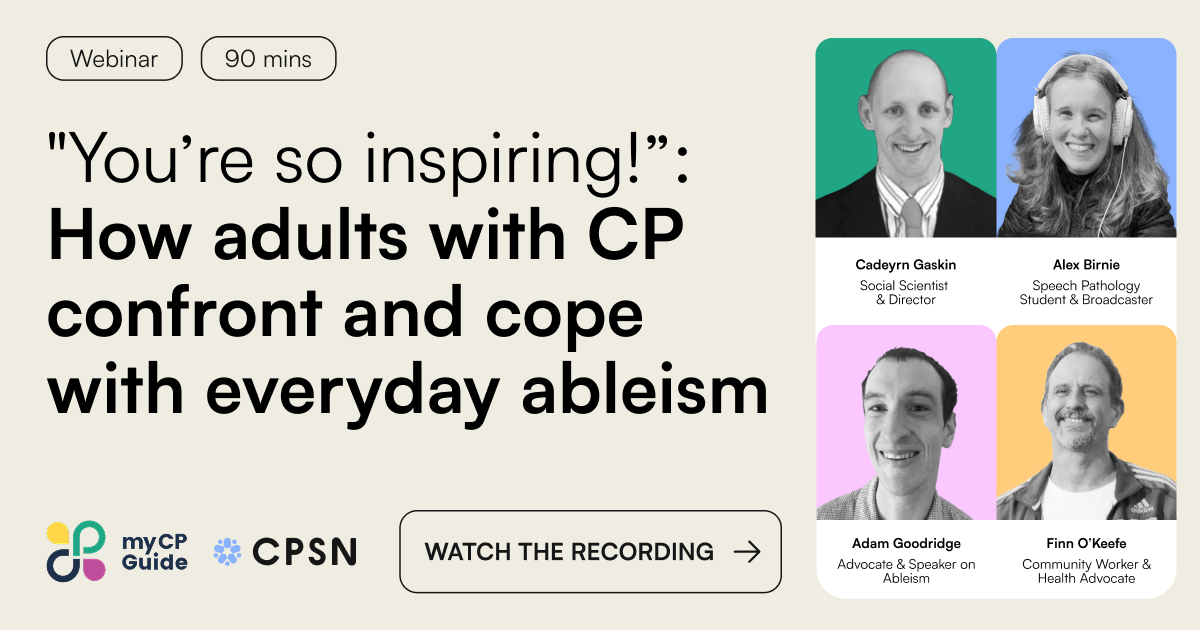
In partnership with My CP Guide, CPSN hosted a webinar exploring ableism through both research and lived experience. The session shared findings from a research project conducted by Deakin University and CPSN, led by Cadeyrn Gaskin (social scientist and research lead) and a research team, made up of people with cerebral palsy and able-bodied allies. The came together to explore an issue central to the lives of adults with CP: ableism, particularly as it shows up in everyday interactions.
As Cadeyrn explained, the goal was to centre lived experience and define success on participants’ own terms:
“We wanted to know how adults with cerebral palsy had successfully confronted ableism…and how they successfully coped with ableism in general.”
The session was presented by members of the research team including Cadeyrn (social scientist and research lead), Adam Goodridge (software engineer), Finn O’Keefe (community worker and advocate), and Alex Birnie (student and community leader).

Watch the full recording here:
Understanding Ableism
Adam Goodridge opened by grounding the audience in what ableism is and how often it goes unrecognised, drawing on both research and personal experience.
Living with cerebral palsy and working as a software engineer, he shared how ableism has shaped his day-to-day life:
“Throughout my life I’ve encountered ableism in many forms - sometimes subtle, sometimes direct, and often even from people who genuinely mean well.”
This perspective reinforced a key message of the session: ableism can appear in many different ways, and is often embedded in everyday interactions that may not immediately be recognised as harmful. Adam refers to it as everyday microaggressions, including infantilising language, being labelled “inspirational” for ordinary tasks, unwanted help, intrusive questions, and being overlooked or spoken for.
These interactions may seem small, but they accumulate over time and shape people’s experiences of the world. Adam talks through various examples of micro-agressions in detail which can be viewed on the full recording.
.png)
Confronting Ableism: What Works
Finn O'Keefe, a community worker with cerebral palsy shared insights from the research on how people with CP respond to ableism in real life, and what “success” looks like.
“It can feel awkward talking about personal achievements. But if you congratulated me for winning an award, I'd feel proud too. But if you congratulated me for catching a bus (which has happened), I’d know you mean well but it feels awkward in a different way. And that’s one of the conundrums of ableism. How do you confront that?”
Finn explained the research explored 23 real-life examples from adults with cerebral palsy, examining how people responded to ableism and what outcomes followed. A key finding was that ableism is not just occasional - it builds over time through both major incidents and everyday micro-aggressions.
“I wish I could hit the pause button on ableism for a while…you have the big moments…but you have all the micro, subtle forms that just continue as well.”
Despite this, many participants found it difficult to identify “successful” examples of confronting ableism. This was often due to self-doubt, the pressure to respond perfectly, and the emotional toll of constantly navigating these situations. External factors also played a role, including well-meaning perpetrators who didn’t recognise their behaviour as ableist.
From these experiences, five key strategies emerged -forming a practical “toolbox” for responding to ableism:
- Educating others to challenge misconceptions
- Demonstrating independence and declining unnecessary help
- Self-advocating, either in the moment or after the fact
- Using humour or bluntness to call out inappropriate behaviour
- Disengaging and removing yourself from the situation
A key insight was that success is not just about changing someone else’s behaviour. As Finn shared through participant insights:
“Success is not a single outcome – it can be whatever allows someone to maintain dignity, a sense of control, and peace with themselves.”
Watch the full webinar recording to hear detailed real-life examples of each strategy in action, and how different responses can lead to different outcomes depending on the situation.

Coping with Ableism Over Time
Alex Birnie's section shifted the focus from responding in the moment to what happens afterwards - how people live with, process, and move forward from ableist experiences.
As she explained, coping is about how people manage stress, not just immediately, but over time:
“Coping simply means how people manage stressful situations.”
The research identified four key ways adults with cerebral palsy cope with ableism:
- Changing their thinking about disability and ableism
- Participating in everyday activities
- Seeking social support
- Trying to change society
A powerful theme was the shift from seeing disability as an individual problem to recognising societal barriers as the issue:
“The problem isn’t me. The problem is ableism and structural issues in society that exclude disabled people.”
Finally, many participants described coping through action by contributing to change. This included educating others, advocating, and embracing disability identity as a source of strength:
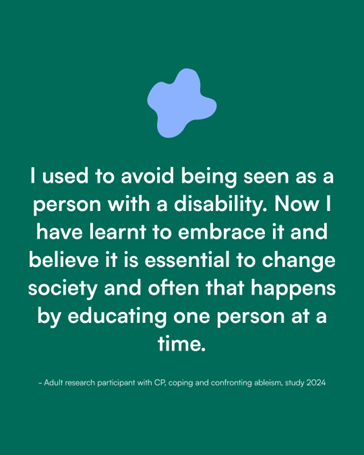
“I used to avoid being seen as a person with a disability. Now… I believe it is essential to change society.”

Key Takeaways
- Ableism is common, often subtle, and widely misunderstood
- Everyday interactions can have a cumulative impact on wellbeing
- There is no single “right” way to respond to ableism
- Confronting ableism can be a form of self-advocacy and empowerment
- Coping involves both mindset shifts and strong support networks
- Change happens both at an individual and societal level
- This research has highlighted that ablesim meansa different things to everyone, and for each individual it will take time to realise what that is and how best to respond to this psychologically and emotionally.
- We are unsure how ableism will change as we age with CP, but the best that we can all do right now is to educate the next generation about it as much as possible.
Learn more
- Watch the full recording or read the research paper ‘How adults with cerebral palsy successfully confront and cope with ableism: a peer-led research project’
- blog articles from My CP Guide.
Where to find support
This webinar includes material on prejudice and discrimination against people with cerebral palsy, as well as sexual references. Some people may find this content distressing. If this is you, please reach out for support if you need it. Your GP is a good place to start.
- Beyond Blue (1300 224 636) - Information on anxiety, depression, and suicide
- Lifeline (13 11 14) - 24-hour crisis support and suicide prevention
- CPSN (1300 277 600)- Cerebral palsy information and support